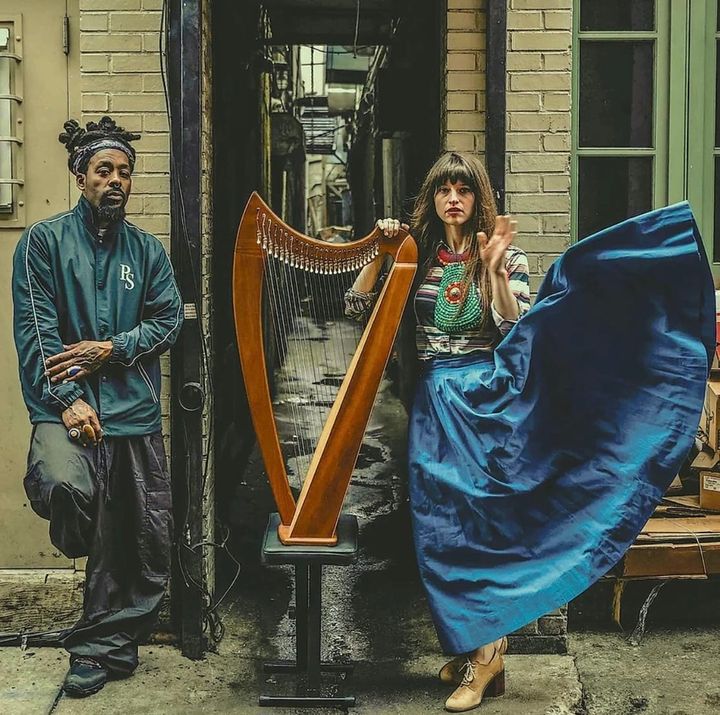
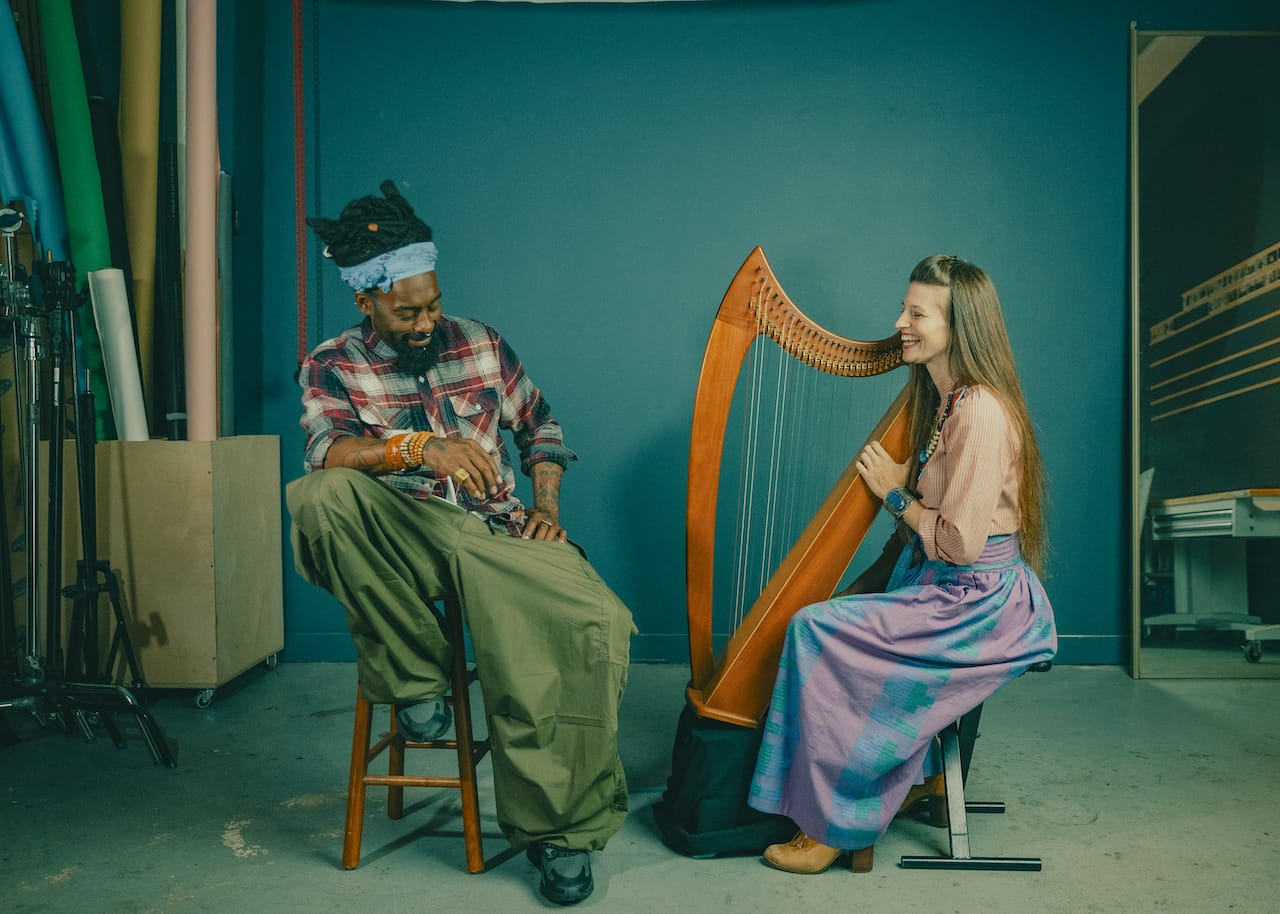
TEDxAsburyPark presents original AsburyPark music artists, Küf Knotz and Christine Elise, at our salon: UNLABEL INTELLIGENCE, on October 7 at the Triumph Brewery Stage in Red Bank.
Musical artists and performers Küf Knotz and Christine Elise blend hip hop, soul, and new age sounds to create original music that defies categorization while expanding the realm of what’s possible.
Knotz and Elise recently spoke with TEDxAsburyPark writer Suzanne Pisano to discuss their soul-satisfying music and their work fostering creative expression and community through the nonprofit organization they founded, Higher Grounds Music.
Pisano: I love the story of how you and Küf met—you saw him perform and then a few months later spotted him at a Whole Foods. It’s like the Universe had a plan.
Elise: It was funny when I saw him, it just was an aha moment—oh, that was an amazing concert I went to, I have to go say something. And so I thought about it after…wow, I just offered to play the harp. And I don't perform, I'm a full-time music therapist. But in the moment, I thought I’ve just gotta do it.
Pisano: And Küf, what were your thoughts?
Knotz: I was shocked at first, but then I was just super curious. What would a harp sound like with my style of music? And so my curiosity definitely got the best of me.
Pisano: Tell me about the musical programs you bring to communities.
Elise: The Higher Grounds Music program evolved out of touring in different communities, and we wanted to expand our reach and go a little deeper into those communities. We do workshops and interactive performances for all ages. We do an elementary school art residency, where we’re meeting with the kids every day. We design an assembly with them and then at the end of the week they perform for their school. We also collaborate with other nonprofits in a community, like an outpatient center or a community center. We try to build a few of those workshops around the tours that we have around the country. So, it organically evolved. We also curate those experiences based on what the organizations that we collaborate with need. So sometimes they're innovative and sometimes they’re things we've done before.
Pisano: Those sound like such enriching experiences. Tell me about your background as a music therapist working with nonverbal or neurodivergent people.
Elise: Before this project, my main job was going into group homes and working with that population. I used to work with children with autism in their schools. That is a magical place to be, to connect to people through music. It just opens up different doors. I have some special stories from those times, of working with those individuals. And I feel like pieces of that have overflowed into this work, that is a lot of where my experience came from. We are everything that we've learned.
Pisano: Indeed we are. I’d love to hear one of those stories.
Elise: One of the schools I worked at was called Overbrook School for the Blind, right outside of West Philly. I was new to being a music therapist, and I went into this classroom and I really didn't know how to navigate. There were five girls in a semicircle, about middle-school age, who didn't use language as their communication. They were all in wheelchairs and they all had a staff member with them to help navigate through their day. The first time I went there, I played my heart out and the energy wasn't coming back to me as I was expecting. And I said to myself, am I really reaching them? Where is this disconnect happening? And I realized I was trying to get these beautiful people to communicate how I communicate. So let me switch that mindset and try to learn how they communicate. And once I did that, I started to see all of these super minute but powerful moments. One of them would blink their right eye to say, ‘yes, I want more’ or one of them would move their leg more when it was something that they enjoyed. And when I started to tune into those really fine moments, I was able to truly learn each one of those individuals and how they were going to communicate with me. It was amazing; to ask them through music, to give them a choice through music, rather than just playing to them. And our relationship really changed, and they made a lot of progress in those groups because they also realized that I wanted to witness them make changes through the music.
Pisano: That is beautiful. Communicating nonverbally through music. Did you study both performance and music therapy?
Elise: Yes, I studied piano performance, but got my master's in music therapy as well. I primarily used guitar when I was a full-time music therapist, because you're able to use your hands, you're able to move around. And we did a lot of improvisation. That was a big part of it, to be able to, on the spot, create a song that's going to make a connection or a change or a movement forward.
Pisano: Amazing. Küf, tell me about your musical journey.
Knotz: I’d say it probably started in a serious way in college. I had always loved music and been into music. My brother was an influence, he used to rap. And so I was always moved by that. But once I got to college, I really dove into doing music. I was part of a few different bands over the years.
Pisano: And where did you go to school?
Knotz: I went to Westchester University for two years, and then the Art Institute in Philadelphia. That's when I really got into music. The year I was at the Art Institute, I was offered a record deal, so I ended up leaving school early to do that. And then I was in a number of different bands; I did a reality show at one point with one of the bands. And then I was doing a solo project, but I still had members of bands playing with me when I was out live. And that was one of the shows Christine saw. So from graduating high school till now, I've just always done music.
Pisano: And like Christine, you always had an interest in working with communities.
Knotz: Yes, we both had a strong interest in working with communities. When I was doing my own thing, I was involved in a lot of fundraisers in different communities. And so it was something I was always interested in and something that Christine had experience in. So I think one of our goals when we decided to work together was to try to incorporate those two things somehow. We learned to focus on each other's strong points to help create that. The first couple of times we did community stuff, like going to a hospital, I was uncomfortable with it. And I had to learn a little bit, and do it a few times hands on. But then it became easier. And gratifying as well.

Member discussion: